
Deploy a Single Project to AWS: The Full Path and a Simpler Option
Follow one web app from source code to public HTTPS on AWS, then see where ProductEcho removes setup steps.
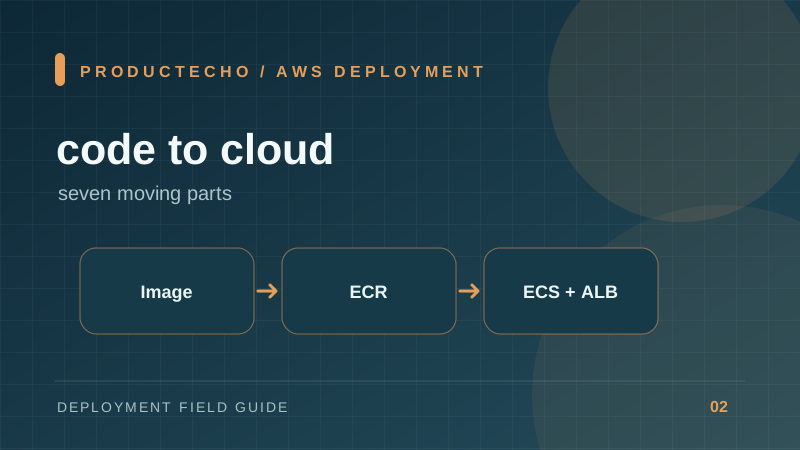
What does “deploy to AWS” mean?
There is no single AWS deployment button for an arbitrary full-stack application. For a containerized app, a common path is Amazon ECR for the image, ECS for the running tasks, an Application Load Balancer for HTTP traffic, IAM for permissions, VPC networking, a certificate for TLS, and a database if the app stores data. Each layer solves a different problem.
This is why “the Docker image pushed successfully” is not a deployment milestone by itself. The image is an artifact. ECS needs a task definition that names the image, CPU and memory limits, container port, and environment. An ECS service then keeps the desired number of tasks running and replaces unhealthy ones.
Trace one request from the browser
Suppose a user opens https://app.example.com. DNS points the hostname to a load balancer. The load balancer presents a TLS certificate and forwards the request to a healthy ECS task. The task runs your container and talks to a database over private networking. A failure at any hop has a different symptom: DNS failure, certificate error, gateway error, application error, or database error.
The load balancer is not a substitute for application readiness. Configure a cheap health route and allow for startup time. Security groups should expose the load balancer publicly while limiting direct access to tasks and the database.
Release a new version
Build an image from a known commit, push it to ECR under an immutable identifier, register a new task-definition revision referencing that image, and update the service. ECS starts replacement tasks according to its deployment configuration. If they cannot become healthy, a configured deployment circuit breaker can fail the rollout and roll back to the last completed deployment.
Keep these identifiers in the release record. “Deploy latest” is hard to reproduce when a mutable tag can point to different bytes later. Run database migrations with the old and new application versions in mind; rolling back containers does not reverse schema changes.
Where a managed app platform changes the work
A managed platform can collapse image building, runtime provisioning, TLS, and public URL setup into one workflow. ProductEcho is useful when the goal is to ship one app quickly through an agent and optionally provision PostgreSQL. Direct AWS control is appropriate when you need its exact IAM, network topology, regional services, or organizational policy. The tradeoff is operational responsibility, not whether one platform is “production” and another is not.
Before choosing, list the requirements: data region, private networking, expected traffic, team ownership, rollback procedure, and monthly fixed costs. This prevents optimizing only for the first deploy.
Further reading
Amazon ECS service load balancing explains traffic routing. ECS deployment circuit breaker documents failed-rollout detection and rollback.