
Staging vs Production: What Should Be Separate?
Design environments that catch release failures without sharing credentials or corrupting live data.
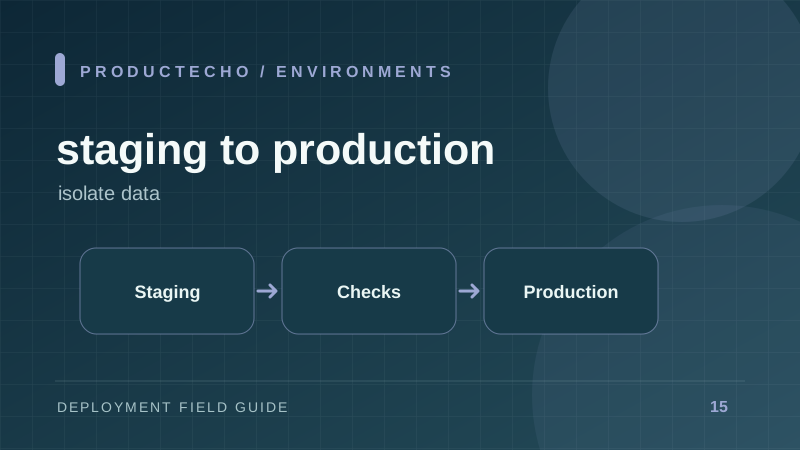
Staging should rehearse a release, not merely host another branch
The purpose of staging is to find failures in the path to production. It should use the same build process and, ideally, the same immutable artifact that production will receive. It should not share production credentials or a production database.
A different branch can hide the very problem staging is meant to expose: the artifact you test may not be the artifact you release. Build once from a commit, deploy that artifact to staging, run migrations and smoke checks, then promote it with production configuration.
Separate what can cause harm
Use distinct databases, API credentials, domains, email senders, payment modes, object storage, and service accounts. A staging URL is not isolation if it can write to live customer data. If a realistic dataset is necessary, sanitize a copy and control who can access it. Do not casually copy raw production data into a broad-access test environment.
Configuration that is inlined at build time complicates “build once, promote everywhere.” Next.js NEXT_PUBLIC_ values, for example, are fixed during the build. Either avoid environment-specific public build values, use a runtime configuration pattern, or accept that separate artifacts need separate testing.
Make staging representative where it matters
It need not have identical scale or cost. It does need enough similarity to catch the failures you care about: operating system packages, network paths, schema migrations, callback URLs, and authentication. For load behavior, use a dedicated performance environment or a controlled test; a tiny staging instance cannot predict production throughput.
Define a smoke suite that covers the real user journey. Run it after staging deployment and again after production deployment. If it fails in staging, stop promotion. If it fails in production, use the recorded artifact and rollback procedure.
Decide what parity is worth paying for
Exact production scale can be expensive and is often unnecessary for functional release checks. Keep parity in the parts that change behavior: runtime versions, build steps, database engine and schema, authentication flow, and network restrictions. Use smaller instance sizes if the app behaves the same at that size, while acknowledging that performance results will differ.
Staging failures often expose hidden external state. A payment webhook may target the production URL, an OAuth provider may reject the staging callback, or an email sender may be blocked in sandbox mode. Keep an environment matrix for these integrations and test at least one full event flow in each environment.
For database migrations, a tiny empty staging database is misleading. Restore a sanitized production-like dataset when the migration's lock and backfill behavior matters. Run the migration with timing and lock monitoring. This rehearsal is especially valuable before adding an index or rewriting a large table.
Further reading
The Twelve-Factor App on dev/prod parity explains why gaps between environments create release risk. Next.js environment variables documents build-time public configuration.