How to Deploy AI Copilot Apps Securely
Learn how to deploy AI copilot applications securely with production-ready hosting, environment separation, secret management, access controls, protected databases, and reproducible deployments.
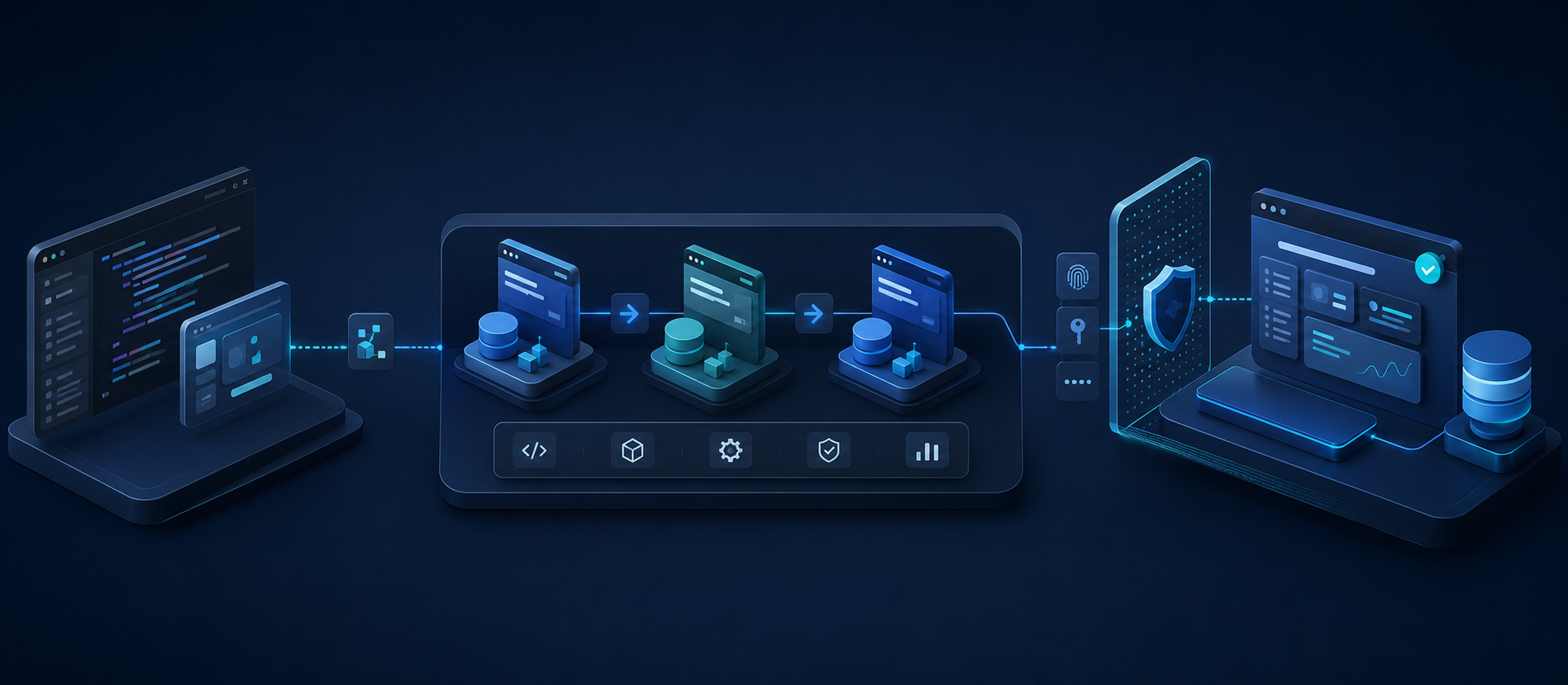
1. Choose Production-Ready Application Hosting
The first step in application deployment is choosing infrastructure that can reliably run the application.
A copilot may generate the application code, but production software still requires:
- Application hosting
- Compute resources
- Networking
- HTTPS
- Environment configuration
- Database connectivity
- Scaling
Teams should avoid treating AI-generated applications as fundamentally different from other production software. Once real users depend on an application, it needs the same operational foundation as traditionally developed software.
The difference is that AI development tools can create applications much faster, so the deployment infrastructure needs to keep up.
2. Separate Development and Production
One of the simplest security practices when deploying AI apps is maintaining clear separation between development and production environments.
AI-generated code can change rapidly. Developers may ask a copilot to rewrite features, modify dependencies, or experiment with new functionality.
Those changes should not automatically affect production.
A practical setup should provide separate environments for:
Development → Testing → Production
This allows teams to validate copilot-generated changes before exposing them to users.
It also makes it easier to investigate problems, test new AI-generated features, and roll back changes when necessary.
3. Protect Application Secrets
AI applications frequently depend on API keys, database credentials, authentication secrets, and third-party services.
These credentials should never be embedded directly into application source code.
Instead, production deployments should use secure environment variables or a dedicated secrets-management system.
This is especially important when working with copilot-built software, because AI-generated code may introduce configuration values across multiple files.
Teams should establish clear rules for:
- API keys
- Database credentials
- Authentication secrets
- Third-party service tokens
- Environment variables
The AI can generate the code, but the team should remain in control of the credentials that code can access.
4. Control Who Can Access the Application
Security does not end with infrastructure.
Organizations deploying AI applications need to decide who can access the application and what those users are allowed to do.
Depending on the application, this may include:
- Authentication
- Role-based access control
- Team permissions
- Administrative access
- API authorization
- Environment-level permissions
Product and IT leaders should define these requirements before an AI-generated application reaches production.
A prototype can be accessible to everyone. A production application handling business or customer data cannot rely on prototype-level access controls.
5. Secure the Database and User Data
Many AI applications rely heavily on persistent data. Copilot applications may store conversations, user profiles, preferences, application state, or business information.
The database therefore becomes a critical part of AI copilot app deployment.
Teams should consider:
- Database access controls
- Encryption
- Credential management
- Backups
- Data retention
- Network security
- Scaling requirements
Database infrastructure should be treated as part of the application rather than an afterthought added after deployment.
6. Make Deployment Reproducible
AI development can produce frequent changes. A production workflow should make those changes predictable.
Teams should know:
- What version is currently running
- What changed between deployments
- Who initiated a deployment
- How to revert a problematic release
- Which environment contains each version
A reproducible deployment process turns rapid AI development into something that engineering and IT teams can actually manage.
7. Use Infrastructure That Matches AI Development Speed
The fundamental challenge with AI-generated applications is speed.
AI development tools can dramatically reduce the time between an idea and a working application. If deploying that application requires manually configuring multiple infrastructure services, much of the productivity gain disappears.
Platforms such as ProductEcho are designed to reduce this gap by connecting AI-driven development with application infrastructure.
Instead of treating application development and deployment as separate processes, the workflow can move from:
AI agent → infrastructure → database → deployment → live application
ProductEcho can provision application infrastructure and PostgreSQL databases while providing a production deployment with HTTPS.
This allows teams to focus on what the AI application does instead of spending their time assembling the infrastructure required to run it.
Final Checklist for Secure AI App Deployment
Before putting copilot-built software into production, verify that you have:
- Production-ready hosting
- Separate development and production environments
- Secure secret management
- Authentication and authorization
- Protected database infrastructure
- Access controls for teams
- Reproducible deployments
- A rollback strategy
- Appropriate monitoring and operational controls
AI can dramatically accelerate software creation, but production deployment still requires discipline.
The goal of AI copilot app deployment is not simply to get an AI-generated application online. It is to create a secure, manageable path from AI-generated code to production software—without sacrificing the reliability and control that real users and organizations expect.