What to Look for in AI Code Deployment Platforms
Learn which infrastructure, deployment, security, automation, and developer-platform capabilities teams should evaluate when deploying AI-generated applications.
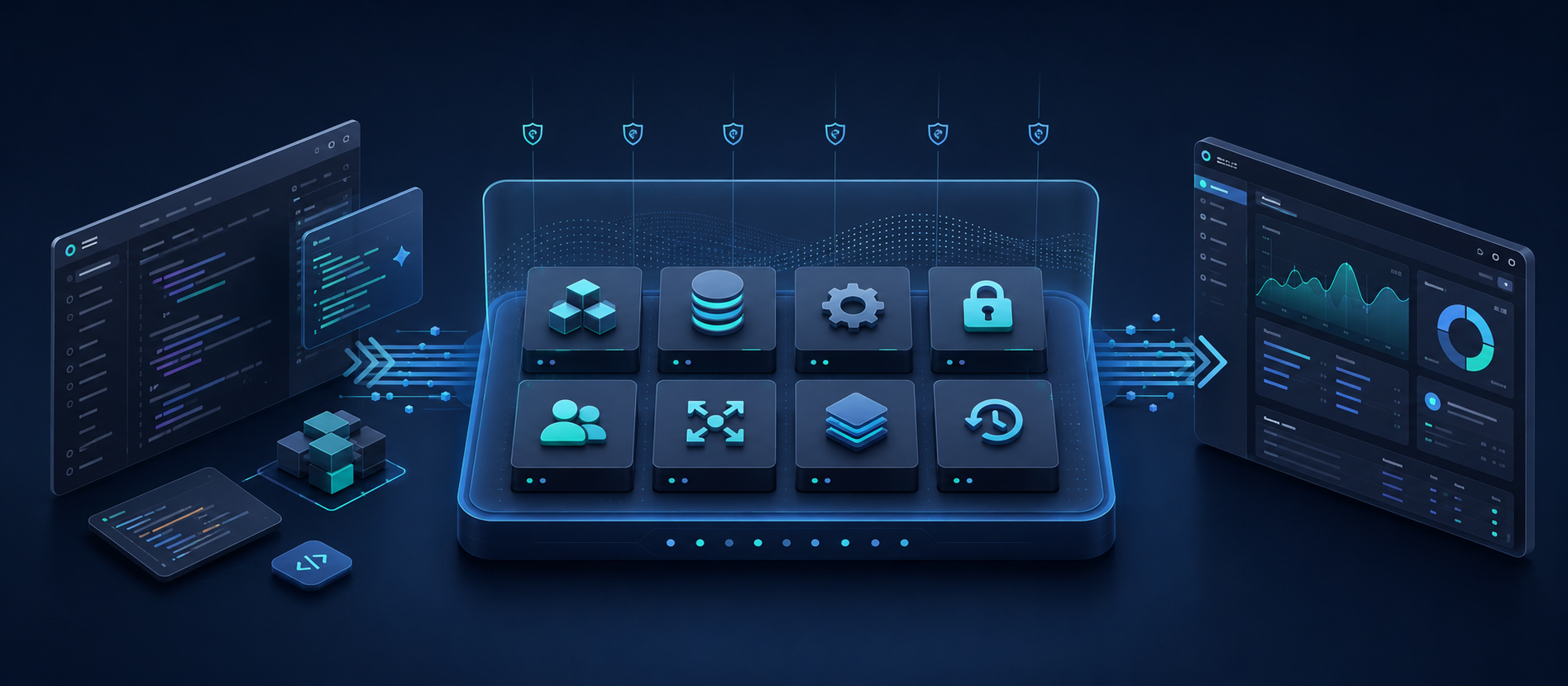
1. Infrastructure Built for AI-Generated Code
Traditional cloud infrastructure assumes developers or DevOps teams will configure the environment, connect services, manage deployments, and troubleshoot production issues.
Agent-generated code changes that equation.
AI agents can produce applications much faster, which means infrastructure needs to support frequent changes without creating additional operational overhead.
Look for platforms that provide:
- Application hosting
- Databases
- Environment configuration
- HTTPS
- Scaling
- Deployment management
The goal is to give AI-generated applications a reliable runtime without requiring every developer to become a cloud infrastructure expert.
2. Simple Agent-Generated Code Deployment
The deployment process should be as straightforward as the development process.
A fragmented workflow might look like:
AI coding tool → GitHub → CI/CD → Cloud provider → Database → Configuration → Production
Every step adds another service and another potential point of failure.
A modern agent-generated code deployment workflow should reduce that complexity.
Ideally, an AI agent can move from writing application code to provisioning the resources it needs and deploying a working application with minimal manual intervention.
This is particularly valuable for teams that want to experiment quickly without building a large deployment pipeline for every new application.
3. Guardrails Without Slowing Developers Down
Automation does not mean removing control.
AI-generated code can change quickly, so deployment platforms need guardrails that prevent mistakes from becoming production incidents.
Useful controls include:
- Environment separation
- Access permissions
- Deployment history
- Version tracking
- Rollbacks
- Secure environment variables
- Controlled infrastructure access
The best platforms make these safeguards part of the deployment workflow rather than forcing teams to build them independently.
4. DevOps-Free Deployment
Not every organization has a dedicated DevOps team.
Startups, product teams, and smaller engineering organizations often need developers to handle infrastructure alongside application development. That does not mean they should have to manually configure every cloud resource.
DevOps-free deployment means abstracting unnecessary infrastructure complexity while keeping the controls required for production.
A good developer platform should handle the repetitive infrastructure work so developers can concentrate on application logic and product functionality.
This is especially important when AI coding tools dramatically increase the number of applications or features a small team can build.
5. Integrated Cloud Infrastructure
AI applications rarely consist of application code alone.
They may require databases, persistent storage, networking, environment variables, authentication, and other services.
Managing each component through a separate provider can create unnecessary complexity.
When evaluating cloud infrastructure for AI-generated applications, consider whether the platform can provide multiple requirements through one workflow.
An integrated platform can reduce:
- Infrastructure configuration
- Service-to-service setup
- Credential management
- Deployment complexity
- Operational overhead
This becomes increasingly valuable as teams move from AI-generated prototypes to production applications.
6. Code Shipping Automation
The purpose of automation is not simply to deploy faster. It is to make deployments repeatable.
Code shipping automation should provide a predictable path from a code change to a running version of the application.
Teams should be able to understand what is being deployed, which version is running, and how to recover if something goes wrong.
For AI-generated applications, this is particularly important because agents may produce changes at a much higher frequency than traditional development workflows.
7. A Platform That Connects Development to Production
ProductEcho is designed around this connection.
Instead of treating AI coding and infrastructure as separate workflows, ProductEcho allows AI agents to interact with application infrastructure through MCP.
The workflow can become:
AI agent → ProductEcho → infrastructure → database → live application
ProductEcho can provision the runtime and PostgreSQL database required by an application, configure its environment, and provide a live HTTPS deployment.
This gives teams a path from generated code to production without requiring them to assemble and maintain a separate collection of infrastructure services.
What Makes an AI Deployment Platform Worth Choosing?
When evaluating developer platforms for AI-generated applications, prioritize simplicity without sacrificing control.
A strong platform should provide:
- Infrastructure designed for AI-generated applications
- Fast agent-generated code deployment
- Built-in guardrails
- Secure environments
- Integrated databases
- Automated application deployment
- Scaling capabilities
- Rollback and version management
- Minimal DevOps overhead
The best infrastructure platform is not necessarily the one with the most cloud features.
It is the one that removes the most unnecessary work between AI-generated code and a production application.
As AI coding tools continue to accelerate software development, deployment infrastructure needs to evolve with them. Teams that can automate the path from agent-generated code to reliable production software will be able to ship faster—without needing to build a large DevOps function just to keep up.