Best Cursor Plugins for Team AI App Development
Explore what teams should look for in Cursor plugins and AI platform integrations, from privacy and deployment to team workflows and editor-to-production capabilities.
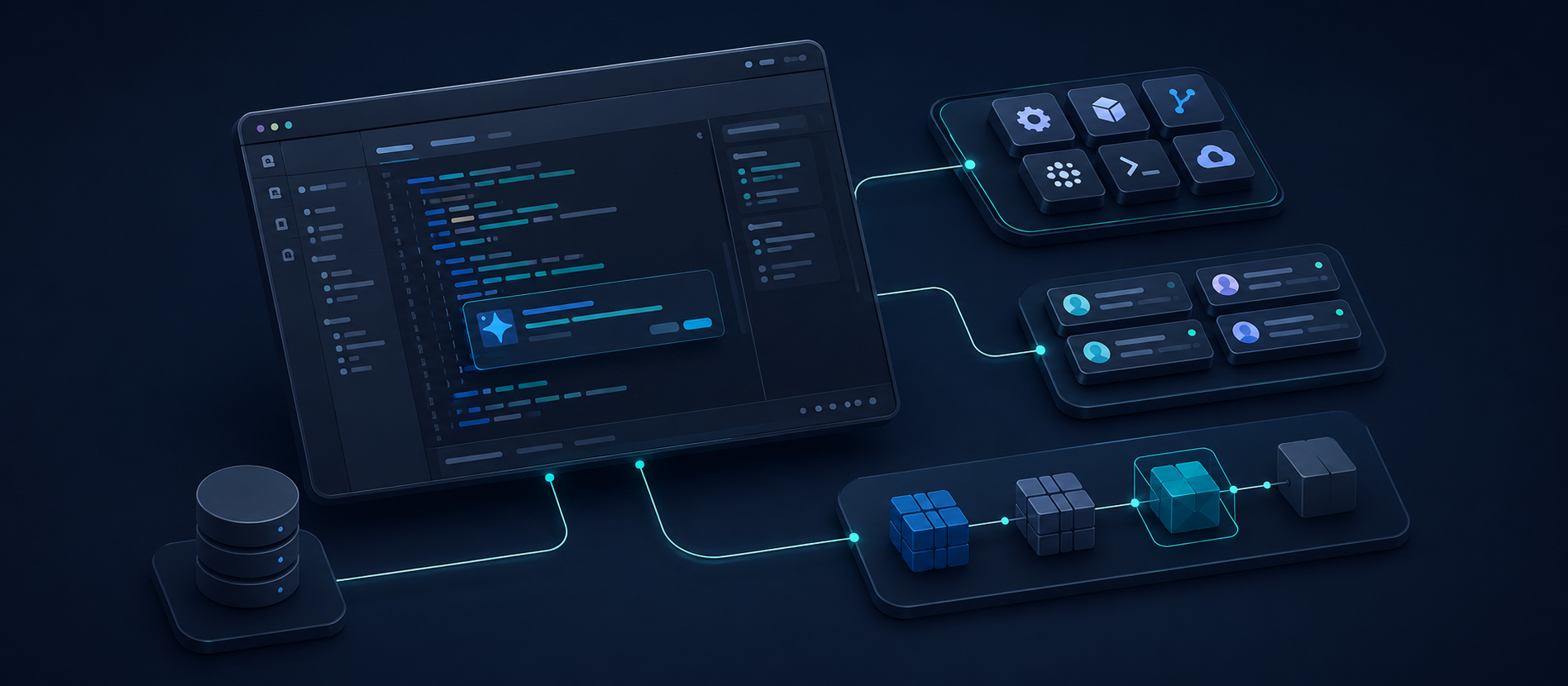
What Are Cursor Plugins and Extensions?
Cursor plugins and Cursor extensions extend the capabilities of the Cursor development environment. They can connect AI agents to external tools, services, APIs, databases, and development workflows.
For individual developers, an extension might improve debugging, code navigation, testing, or language support. For teams, the more important question is whether an integration can become part of a complete team development workflow.
Modern AI application development increasingly looks like:
Idea → AI-generated code → Infrastructure → Deployment → Production
A plugin that only helps with the first step may improve developer productivity, but it does not necessarily solve the challenges that come afterward.
What Teams Should Look for in AI Platform Integrations
When choosing tools for AI app development in Cursor IDE, development teams should evaluate four major areas.
1. Privacy and Compliance
AI applications can involve source code, customer information, credentials, and other sensitive data. Teams should understand what information an integration sends to external services and where that information is stored.
For privacy-focused AI development, look for clear data-handling policies, access controls, and appropriate security and compliance capabilities.
This becomes particularly important for teams building compliant AI applications or applications that may eventually handle production customer data.
2. Deployment Workflow
A common development workflow can involve several disconnected services:
Cursor → GitHub → CI/CD → Cloud provider → Database provider → Production
Every additional service introduces configuration, credentials, integrations, and potential failure points.
A better AI development workflow can reduce these steps:
Cursor → AI agent → Deployment platform → Production
The closer deployment is to the development environment, the easier it becomes for teams to move quickly without creating unnecessary infrastructure work.
3. Team Development Workflows
Individual productivity is only one consideration.
Teams need consistent environments, predictable deployments, shared infrastructure, access controls, and a workflow that multiple developers can understand and reproduce.
When evaluating Cursor extensions or AI platform integrations, ask:
- Can multiple developers use the same platform?
- Can AI agents interact with infrastructure directly?
- Are environments easy to reproduce?
- Can teams control access?
- Can applications be deployed consistently?
4. Editor-to-Production Capability
The biggest opportunity for AI development is connecting the editor directly to production infrastructure.
AI agents can now generate significant portions of an application extremely quickly. If developers still need to manually configure hosting, databases, environments, and deployment afterward, infrastructure becomes the bottleneck.
This is why editor-to-production capability is an important differentiator for AI application teams.
ProductEcho for AI App Development in Cursor
ProductEcho is built to connect AI coding workflows with application infrastructure.
Through MCP, an AI agent can interact with ProductEcho while building an application. Instead of stopping after generating code, the workflow can continue toward a deployed application.
The process becomes:
Cursor → AI agent → ProductEcho → Live application
ProductEcho can provision the runtime and database required by the application, configure its environment, and provide a live HTTPS deployment.
This reduces the need for developers to manage multiple infrastructure platforms simply to get an AI-generated application running.
PostgreSQL Without Another Platform
Databases are a critical part of most AI applications. Conversations, users, preferences, application state, and other persistent information need reliable storage.
ProductEcho provides PostgreSQL as part of the application infrastructure, including PostgreSQL 14 and 16.
Applications can also scale dynamically without downtime, allowing teams to move beyond prototypes without redesigning their infrastructure workflow.
For teams experimenting with new AI applications, the free plan includes 1 GB of PostgreSQL storage, with Pro scaling to 5 metered databases up to 200 GB.
How to Choose the Best Cursor Integration
There is no single best Cursor plugin for every development team. Instead, evaluate each integration against the workflow you actually need.
Look for:
- Strong Cursor compatibility
- AI-agent support
- Simple deployment
- Integrated databases
- Scalable infrastructure
- Privacy controls
- Compliance capabilities
- Team collaboration features
- Reliable production workflows
The goal is not to collect more Cursor plugins or Cursor extensions.
The goal is to create a development workflow where AI can take an application from code to production without forcing the team to manage unnecessary infrastructure.
As AI coding agents become more capable, the next competitive advantage will not simply be writing code faster. It will be the ability to turn that code into reliable, production-ready applications just as quickly.