How to Launch AI Prototypes as Live SaaS
Learn how to turn AI-generated prototypes into live SaaS products with production-ready architecture, PostgreSQL, secure environments, repeatable deployment, and minimal infrastructure work.
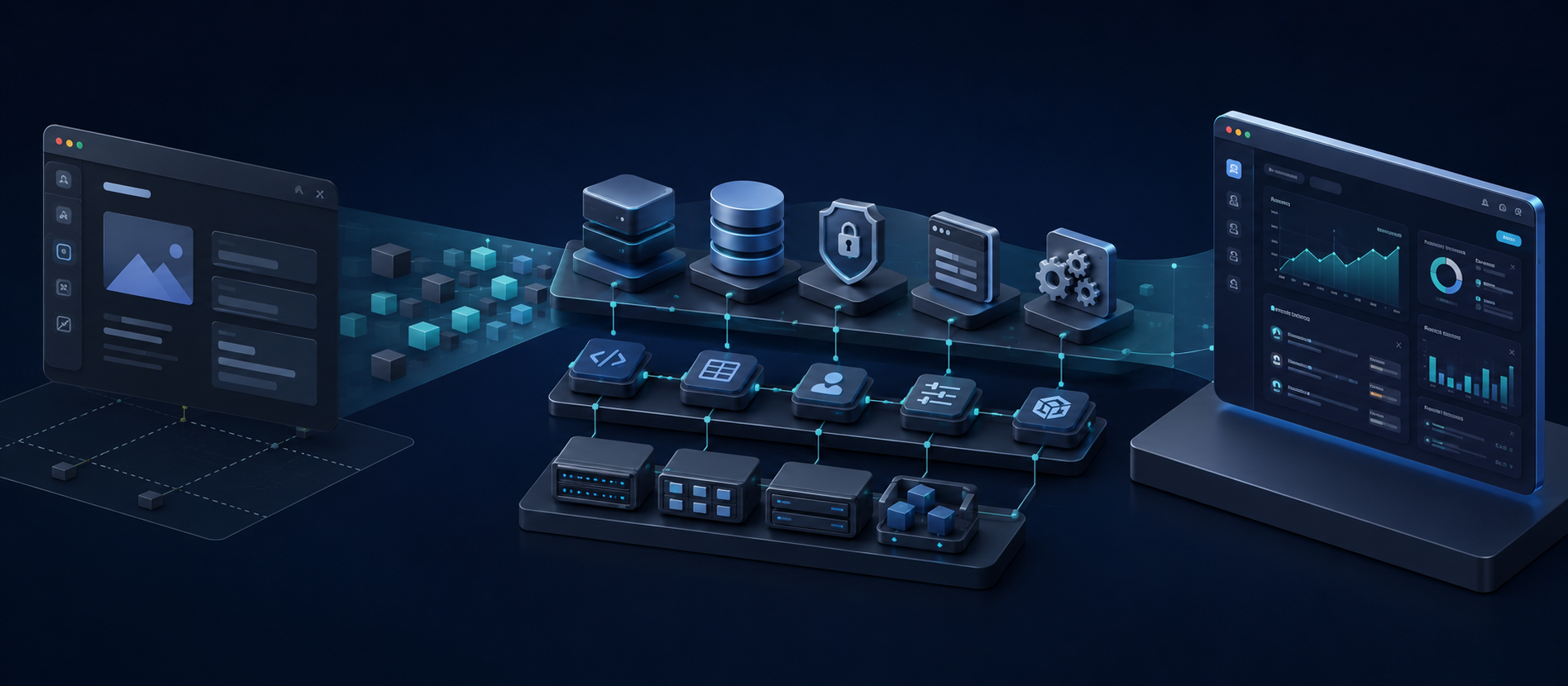
1. Start With a Real Application Architecture
The first step is making sure your prototype is more than a collection of screens.
A production SaaS application needs:
- Application logic
- Persistent data
- User authentication
- Environment configuration
- A production runtime
- Secure deployment
AI app builders can accelerate the initial development, but founders should evaluate whether the generated application has a foundation that can support real users.
The goal is not to make the prototype perfect. It is to make sure the path to production does not require throwing away the work that has already been created.
2. Add a Production Database
Most SaaS products need persistent data.
Users, accounts, preferences, subscriptions, conversations, settings, and application state all need reliable storage.
During early SaaS application development, teams sometimes use temporary or development databases simply to validate an idea. Before launch, that data layer needs to become production-ready.
A managed PostgreSQL database can provide a practical foundation while removing much of the operational work involved in running database infrastructure yourself.
The important consideration is whether your deployment platform can provision and connect the database as part of the application workflow.
3. Separate Prototype and Production Environments
An AI-generated prototype may change frequently.
Founders can ask an AI agent to modify features, redesign interfaces, or experiment with entirely new functionality. Those changes should not automatically affect customers.
Use separate environments for:
Development → Testing → Production
This gives the team a safe place to iterate while keeping the live SaaS application stable.
Environment separation also makes it easier to test AI-generated changes before releasing them to users.
4. Make Deployment Repeatable
The fastest way to launch is not necessarily the fastest way to deploy once.
A SaaS product will need many deployments after launch.
You will fix bugs, add features, change integrations, and respond to customer feedback. A good deployment workflow should make these changes predictable rather than turning every release into an infrastructure project.
This is where rapid app deployment becomes valuable.
Instead of manually configuring servers and infrastructure for every release, the deployment process should be repeatable:
Code → Build → Deploy → Live application
The less manual infrastructure work required between those steps, the faster a startup can iterate.
5. Don't Rebuild Just Because the Prototype Was AI-Generated
One common mistake is assuming that an AI-generated prototype must be rewritten before it can become production software.
That is not always necessary.
If the generated application has a reasonable architecture, the better approach may be to progressively harden it:
- Add authentication
- Secure environment variables
- Connect production databases
- Configure deployment
- Add monitoring
- Test critical workflows
- Establish rollback procedures
This approach preserves the speed advantage that AI development provides.
The objective is to move prototype-to-production, not prototype-to-rewrite-to-production.
6. No-Code vs. AI Code Generation
No-code app development and AI-assisted development solve similar problems but take different approaches.
No-code platforms can be excellent for validating workflows without writing traditional code. AI app builders go further by generating actual application code that can potentially be customized and extended by developers.
For SaaS founders, this distinction matters.
A prototype should not only demonstrate what the product could look like. Ideally, it should provide a foundation that can continue evolving as the business grows.
7. Use Infrastructure Designed for Fast AI Development
The final piece is the infrastructure connecting the generated application to production.
ProductEcho is designed to shorten that path.
AI agents can interact with ProductEcho through MCP while building an application. ProductEcho can provision the application runtime and PostgreSQL database, configure the environment, and provide a live HTTPS deployment.
The workflow becomes:
AI app builder → ProductEcho → database + runtime → live SaaS application
Instead of rebuilding the application on another platform after validating the idea, founders can move the existing AI-generated application toward production using the same underlying workflow.
That is particularly useful for startups where speed matters and there is no dedicated DevOps team.
From Prototype to Production Without Starting Over
AI app builders have dramatically reduced the time required to validate SaaS ideas.
The next challenge is turning that speed into a sustainable production workflow.
Before launching, make sure your AI-generated prototype has a production-capable runtime, persistent database, secure configuration, separated environments, and a repeatable deployment process.
With the right prototype-to-production tools, the path can be much simpler:
Idea → AI-generated prototype → Production infrastructure → Live SaaS
You do not need to throw away the prototype simply because it was built with AI.
The better goal is to make the distance between the first working prototype and the first real customer as small as possible.