
MonoRepo for AI Assisted Coding: Helps Lean Team
Why a monorepo gives AI coding agents one place to read and change code, what a lean team gains, the myths, and a checklist to pass before you migrate.
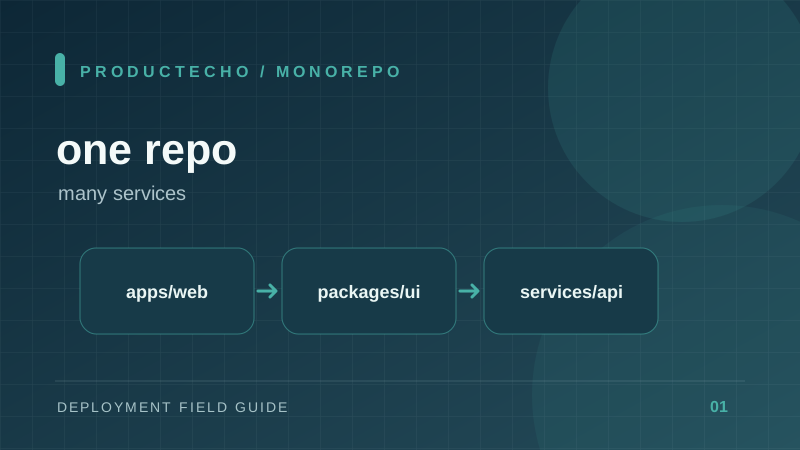
The short answer
A lean team that writes code with AI agents should seriously evaluate a monorepo, because the repository boundary, not the service boundary, now limits what an agent can see and change. Keep microservices for deployment and scaling, but put their code in one repository so people and agents can read, change and test across services in a single pull request.
- Microservices solve scaling and team-independence problems. A monorepo does not undo them.
- One repo per service adds coordination cost, and a lean team has no platform group to absorb it.
- A monorepo gives agents one place to read, search, debug and change code, and gives the team one set of standards.
- Migrate only after the checklist below passes. The misconceptions section covers what usually holds teams back.
Why microservices and independent teams work
Microservices let a growing organization scale both software and people without everyone blocking each other. The benefits come from runtime and ownership boundaries:
- Independent deployment. Each service ships on its own cadence and rolls back on its own.
- Independent scaling. A hot path such as payments or search scales without scaling everything else.
- Fault isolation. One failing service has a smaller blast radius than one failing monolith.
- Team autonomy. Service boundaries mirror team boundaries, so teams own, plan and release their work without waiting on others.
- Technology fit. Each service can use the stack that suits its job.
These benefits are real, and they are architectural. They hold whether the code lives in one repository or fifty.
The cost is that "one repo per service" usually comes with the architecture. Shared libraries must be versioned and published. A change that crosses services needs several pull requests merged in the right order. Every repo carries its own pipeline, dependency updates and conventions. Organizations with many teams accept this because each team owns and maintains its own repos. The question for a lean team is who pays that tax.
What changes with a lean team and AI-assisted coding
With a small team and agents writing much of the code, the trade-offs behind a many-repo microservice setup shift in three ways.
- Teams no longer map to repos. A few engineers own many services and review all of them. The autonomy that separate repos protect barely exists, while the cost of maintaining a distributed source layer stays.
- The bottleneck moves from writing code to giving context and reviewing output. An agent works inside the repo it was opened in. With services split across repos, it sees one slice, guesses at the contracts on the other side, and turns one feature into several checkouts and pull requests that a human must stitch together.
- Debugging crosses service lines. An agent that can read caller and callee in the same tree can trace a failing request end to end, propose a fix and add a test in one pass. Across repos, someone must first decide which repos to load.
The result: a microservice architecture spread over many repos, run by a lean team, with AI agents doing most of the coding, is now a poor fit. Moving toward a monorepo is the more sensible direction.
Benefits of a monorepo in an AI-assisted workflow
A monorepo puts the code of many services in one repository. Each service still builds, deploys and scales on its own.
- Easy visibility. In a microservice mesh, reading the code to understand how a flow works means hopping between repos. In one tree, you and the agent can search and follow it end to end.
- Shared code without the overhead. Common libraries, utility files and encryption or security helpers live in one place. There is no publish-and-version cycle, and a fix to a shared helper reaches every service in one change.
- Improved collaboration. Distributed source repositories are hard for a small team to maintain. One repo means one history, one pull request for a cross-service change, and one review where the whole change is visible.
- Easier agentic reading. Agents do better with the full picture. They can read both sides of a contract, follow a bug across services, and refactor a shared interface and all its callers together. This is where AI-assisted programming and a monorepo fit each other most: debugging gets easier because the agent no longer has to pick among multiple repos to find the issue.
- Standardization across the organization. Policies are set once and applied everywhere: test coverage thresholds, a single view of how everything deploys, and a known rollback plan. Lint, CI and dependency versions follow the same rule.
A monorepo gives an agent access, not focus. Loading everything is not the goal. Keep a root AGENTS.md (or CLAUDE.md) plus short per-service instructions, scoped test commands, and clear module boundaries so the agent reads only what the task needs. Because an agent can now change more files in one go, tests and ownership rules matter more, not less.
Common misconceptions about monorepos
Most objections come from mixing up where the code lives with how it is built and deployed.
| Misconception | Reality |
|---|---|
| A monorepo is a monolith. | It is a code-organization choice. Services keep their own runtime, deployment and scaling. |
| Everything builds and deploys together. | With path-based pipelines and affected-only builds, a change to one service builds and ships only what it touches. |
| Teams lose independence. | Ownership files and per-path review rules keep teams in charge of their areas. Independent release pipelines stay. |
| Git cannot handle it. | Google and Meta run huge monorepos on custom tooling. A lean team's repo is small, and partial clone and sparse checkout cover growth. |
| You need Bazel-class tooling. | Start with workspace tooling for your stack, such as pnpm workspaces, Turborepo or Nx. Move to heavier build systems only if you outgrow it. |
| It forces one language or stack. | Polyglot monorepos work. You standardize the workflow, not the language. |
| Anyone can change anything. | Open read access does not mean open merge rights. Protect paths with code owners and required reviews. |
| AI will understand it all automatically. | Agents still need scoped instructions, clear boundaries and fast, targeted tests. A bigger tree without structure adds noise. |
| Migration is all-or-nothing. | You can move a few services first, keep the rest where they are, and expand once the pilot works. |
Checklist before migrating
Work through these before moving anything. Gaps are fine if you have a plan for them. Unknowns are not.
Fit
- The team is small enough that the same people review and maintain most services.
- You have counted how often one feature needs pull requests in more than one repo. A high number is the strongest case for migrating.
- Services share code today: libraries, schemas, API contracts, encryption or auth helpers.
- No legal, compliance or customer rule requires repo-level access separation. This matters in regulated domains such as fintech.
Delivery and safety
- Each service already deploys independently, with its own versioning and a documented rollback plan.
- CI can run path-based and affected-only builds, with caching, so one change does not rebuild everything.
- Test coverage is good enough to catch breakage across services. This matters more when agents make wide changes.
- Secrets, environments and deployment credentials can be scoped per service inside one repo.
- Ownership is defined per path with code owners, protected branches and required reviews.
Repository and tooling
- You have an inventory of every repo: language, size, dependencies, owner and release process.
- You have chosen workspace and build tooling that fits your stack.
- You have a plan to keep git history, for example with
git subtreeorgit filter-repo. - There is a single policy for dependency versions across services.
- Large binaries and generated files have a plan, such as Git LFS or exclusion.
AI readiness
- A root
AGENTS.mdorCLAUDE.mdexists, with per-service instructions for build, test and conventions. - Agent changes go through the same review and CI gates as human changes.
- Agents have scoped permissions, so they cannot touch deployment config or secrets without review.
People and culture
- The team agrees on shared ownership, one set of standards, and one place for decisions. Culture is the first challenge: a monorepo exposes habits that separate repos used to hide.
- The team has agreed how to review AI-written changes that now span several services.
- You have chosen success measures before starting, such as cross-repo pull requests per feature, lead time, CI minutes and agent task success rate.
Migration approach and when to stay polyrepo
Migrate in steps and keep the old repos working until the pilot proves itself.
- Pick a pilot of two or three services that change together often.
- Set up the workspace, package manager and build tooling in the new repo.
- Import the pilot services with their history.
- Add path-based CI, affected-only builds and caching, then check that each service still deploys alone.
- Add code owners, required reviews and the
AGENTS.mdfiles. - Run the pilot for a few weeks against the success measures you chose.
- Move the remaining services in waves, then archive the old repos as read-only.
Stay polyrepo, or move only part of the code, if:
- Several independent teams with separate roadmaps and release cycles own the services.
- Compliance or contracts require strict access separation between codebases.
- Services share almost no code and rarely change together.
- Parts of the code are open source or shared with outside parties on their own release schedule.
Deploying a monorepo on ProductEcho
Paste your GitHub link and ProductEcho finds the services in the repo that can be deployed. Pick the one you want and you're done, with no CI/CD pipeline to write.